Ceramic
Nano ceramic film, and when it is the wrong answer
Ceramic films use non-conductive nano particles instead of metal. No mirror, no signal interference, better colour stability. They also cost more than metallised film and reject less heat at the same VLT — which is the part the brochure leaves out.
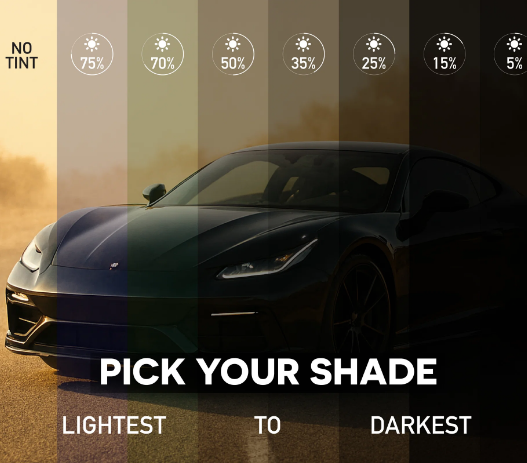
Detail
What ceramic buys you
A ceramic layer absorbs and re-radiates rather than reflects. The glass keeps a neutral look, mobile and Wi-Fi signals pass, and the colour does not drift the way dyed film does after a few summers.
For a hotel lobby, a listed building or a facade with a design review, that appearance is the whole specification. For a warehouse that needs the heat out and does not care about the tint, metallised film does more work for less money.
Range
Architectural and automotive are different products
The architectural film is built for flat glass and long service life. The automotive film is built for curved glass, shrinkability and abrasion resistance — a different construction, not the same roll cut smaller.
Tell us which market you are buying for. Sending architectural stock to a tint shop is a return waiting to happen.
Comparison
Ceramic against metallised, on the numbers that matter
The ceramic advantage is optical and electrical, not thermal. A non-metallised construction keeps a neutral colour at low visible transmission, does not corrode at the edge, and does not attenuate mobile or Wi-Fi signal. On a building with weak indoor coverage that last point alone justifies the price.
What it does not do is out-reject metal. At the same visible light transmission, a metallised film generally delivers a lower SHGC because reflection is a more efficient way to keep energy out than absorption. Ceramic absorbs, then re-radiates; some of that energy still ends up inside, and the glass runs hotter than it would under a reflective film.
So the specification question is not "which is better" but "which constraint binds". Signal integrity, colour neutrality, edge corrosion on coastal sites, and low visible transmission without a mirror look — those point to ceramic. Maximum heat rejection per unit of visible light, on a building with good coverage, points to metallised.
| Constraint | Ceramic | Metallised |
|---|---|---|
| Signal transparency | Passes | Can attenuate |
| Colour neutrality at low VLT | Good | Tends to a mirror cast |
| Heat rejection at equal VLT | Lower | Higher |
| Edge corrosion risk | Low | Higher on coastal sites |
| Cost per square metre | Higher | Lower |
Supply
What a ceramic order looks like from Hubei
Ceramic is a coating process with a longer setup than a dyed or metallised line, so the practical minimum order is set by the run rather than by the roll. Distributors typically order a mixed pallet — two or three ceramic grades plus metallised volume — and we quote it as one shipment with one set of documents.
Roll format is the standard 152 cm master, or slit to your market's working width. Slitting matters more on ceramic: the film is stiffer than a dyed construction and a badly slit edge shows at installation.
For automotive ceramic the constraints change — narrower rolls, different thickness, and appearance matched to interior trim rather than to a facade. Keep the two ranges on separate purchase orders so the batch records stay clean.
Questions
Before you ask
The three questions that come up on almost every enquiry.
Is ceramic film worth the price difference?
Where appearance, signal transparency or colour stability matter, yes. Where the only goal is heat rejection on a building nobody photographs, a metallised film usually wins on cost per square metre.
Do you offer ceramic in both architectural and automotive grades?
Ask for the current line card — the two are separate constructions and availability differs by thickness and width.
Can it be private labelled?
Yes, with a minimum quantity per SKU. See the OEM page for what can be changed and what cannot.
Is ceramic film worth the premium?
On a coastal site, a building with poor mobile coverage, or a facade where a neutral look at low visible transmission is the design intent, yes. On a warehouse with no signal problem and no aesthetic brief, the premium buys very little.
Does ceramic film block 5G or Wi-Fi?
Non-metallised ceramic constructions are designed not to. That is their main electrical advantage over metallised film. Test on site if coverage is already marginal — film is one variable among several.
Why is ceramic heat rejection sometimes lower than metallised?
Because it absorbs and re-radiates rather than reflects. Part of the absorbed energy still crosses into the room. The visible light transmission is comparable; the total solar energy rejected is usually not.
Can ceramic be used on exterior applications?
Only in an exterior-grade construction with a hard coat and a UV-stable build. A standard interior ceramic film applied outside will fail at the edge within a season or two.
Related
Keep reading
Send the specification
Tell us the glass, the quantity and the destination port. You get film grade, documents and MOQ in one reply.