Heat rejection
Heat rejection film for buildings that cannot add shading
Shading devices need permission, budget and a facade that can carry them. Film is applied to glass you already own, from the inside, in hours. We supply the rolls; your installer does the rest.
Detail
Where the heat actually comes from
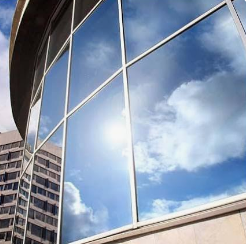
On a west elevation, most of the cooling load after 3pm is solar gain through glass, not air temperature. A metallised film reflects part of that energy before it crosses the pane, so the chiller sees a smaller load in the hours when it is already working hardest.
That is also why film is not a night-time product: it changes nothing once the sun is down, and it cannot fix a building whose problem is a server room with no extract.
Specification
What we need from you before quoting
Three facts decide the grade: the glass build-up (clear float, tinted, laminated, sealed unit), the elevation, and the room behind it. Send those and we quote a film, not a colour card.
For large panes, tinted glass or sealed units we ask for a thermal stress check first. Dark film on annealed glass is the classic way to turn a heat problem into a cracked pane.
- Interior and exterior grades
- Rolls or slit to your width
- Migration-safe packing for sea freight
- Datasheet issued per batch
Cost
The only honest way to price a heat problem
Buyers ask what percentage of the cooling bill film removes. The answer is not a property of the film — it is a property of the building. Glazing ratio, orientation, shading, internal gains, chiller efficiency and tariff all move the number by more than the film choice does.
The workable method is to model the elevation, not the product. Take the glazing area on the problematic orientation, the existing glass specification, and the metered consumption for the cooling season. Then compare the film's measured SHGC against the glass's current SHGC. That gives a defensible saving range, and it gives the client a number they can check against last August's bill rather than a brochure claim they have to trust.
Where the client will not fund a study, the pragmatic route is a single-elevation pilot. Film one floor, measure for a month, then decide. It is slower, but it is the argument that survives a finance committee — and it sells the second order better than any datasheet.
| Factor | Moves the result | Why |
|---|---|---|
| Glazing area on the hot elevation | High | The film only acts on glass |
| Existing glass SHGC | High | A low-SHGC glass leaves little to remove |
| Orientation and shading | High | West and unshaded glazing dominate |
| Internal gains | Medium | Equipment load caps what film can save |
| Film grade | Medium | Second-order next to the glass and the elevation |
Procurement
Comparing two suppliers who quote the same numbers
Two quotations with identical VLT, IR rejection and TSER are not the same product. The figures are usually measured on a 3 mm clear float sample in a laboratory, and your building is not that. What separates suppliers is what happens on a tinted, laminated or low-E pane, and whether anyone will tell you the film is unsuitable before you buy it.
Ask for three things and the conversation sorts itself out. First, the test method behind each figure, not just the figure. Second, the batch record for the rolls you are buying — a datasheet without a batch number cannot be checked against anything. Third, the supplier's own guidance on glass types and thermal stress. A supplier with no stated exclusions has not thought about it.
The commercial side is simpler than most buyers expect: the price difference between a good film and a marginal one is small next to the cost of a failed installation on a facade. Buy on the exclusions and the documentation, not on the third decimal place of an IR number.
Series
Heat rejection range
Thickness and measured figures are confirmed on the datasheet for your batch.
| Series | Thickness | Appearance | MOQ | Price |
|---|---|---|---|---|
| One-Way Vision Solar Film | 2 mil (confirm) | Reflective | On request | Quote on request |
| Mirror Reflective Film | 2 mil (confirm) | Mirror | On request | Quote on request |
| Exterior-Grade Film | 4 mil (confirm) | Tinted | On request | Quote on request |
Questions
Before you ask
The three questions that come up on almost every enquiry.
How much can film reduce the cooling load?
It depends on the glass, the orientation and the film. Rather than publish a percentage that will not survive scrutiny, we send the measured data for the construction you order and let your engineer model it.
Can film be applied to sealed units?
Yes, but the risk is thermal stress on the edge seal, not the glass. Large units on a hot elevation need a stress check before the film goes on. We will ask.
Do you supply the installation?
No — we are the film supplier. Your installer applies it. If you need an installer in your market we can tell you what to look for, not who to hire.
Will film stop the air conditioning from running?
No. It reduces the solar load the system has to remove, which lowers run time and improves the temperature the system can hold on the hottest days. Buildings with undersized plant often feel the difference as comfort rather than as a bill reduction.
Does heat rejection film work on north-facing glass?
Much less. On a shaded or north elevation the solar gain is small and the film mostly buys glare control. Say so — selling a heat product on a shaded face is how a supplier loses a distributor.
What is the difference between IR rejection and TSER?
IR rejection covers a slice of the solar spectrum. TSER covers the whole of it — ultraviolet, visible and infrared — and is the number that predicts cooling load. A high IR figure with a modest TSER is a marketing number.
Can I film only the worst elevation?
Yes, and it is often the right first phase. Keep the same series and batch for the rest of the building so a later phase matches, and agree in writing that a partial elevation is a deliberate decision.
Related
Keep reading
Send the specification
Tell us the glass, the quantity and the destination port. You get film grade, documents and MOQ in one reply.