Security
Security film for storefronts that get hit at 3am
Smash-and-grab is a two-minute crime. A filmed pane turns a clean break into a struggle: the glass cracks but stays put, and the delay is usually enough. It is not a force field, and anyone selling it as one has not been on site at 3am.
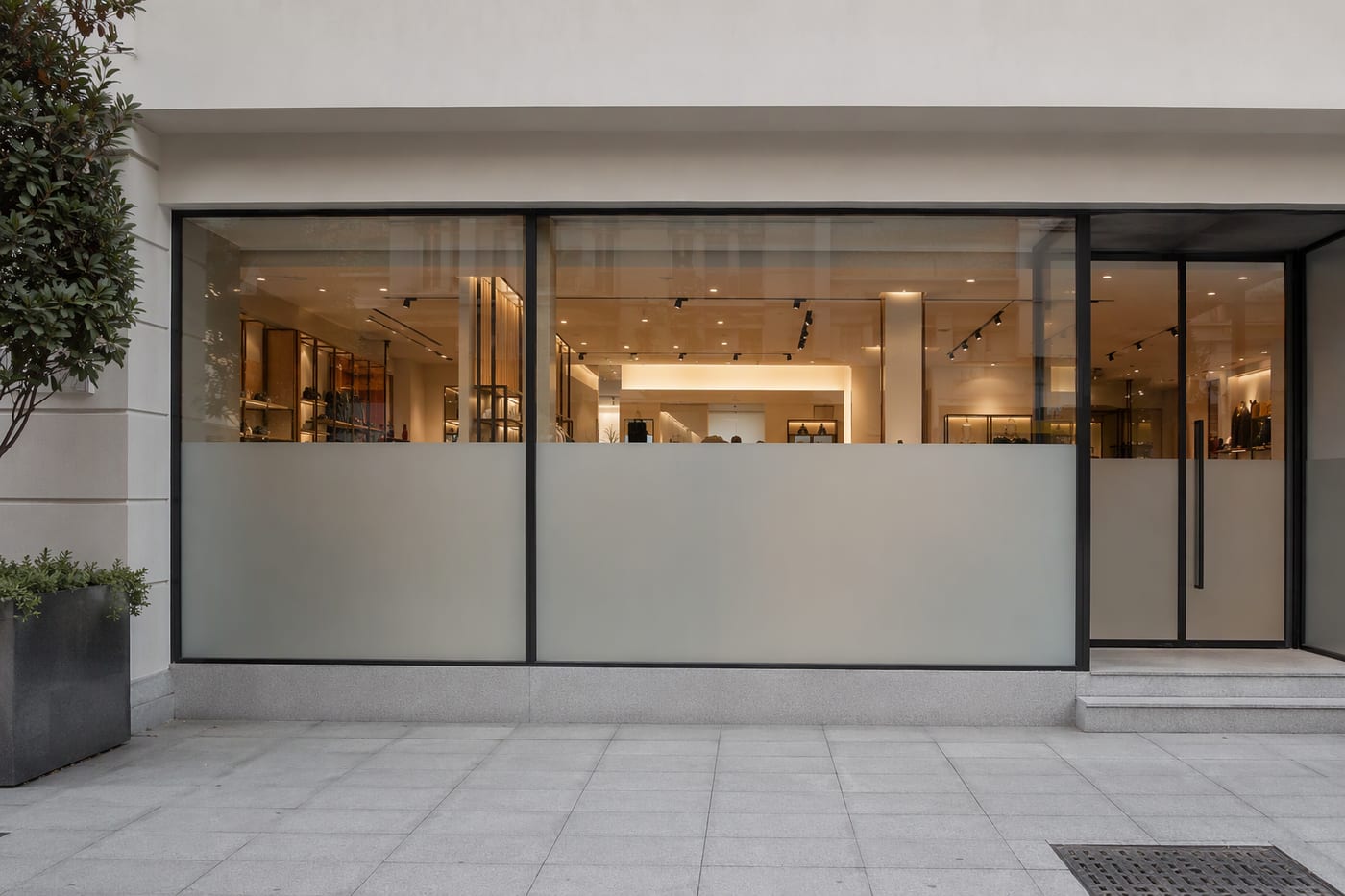
Detail
Delay, not prevention
The film holds the pane together after impact. Against an opportunist with a hammer, that changes the timeline: no quick hole, no clean reach-in, more noise, more time in view of a camera.
Against a prepared intruder with the right tool, film buys seconds. If the risk assessment says otherwise, the answer is laminated glass with an anchored frame — and film is a retrofit compromise, not an equivalent.
Specification
The frame decides the result
A filmed pane that pops out of its gasket is a filmed pane on the pavement. Anchoring systems — wet glaze, structural silicone, mechanical retention — are what keep it in the opening, and they are chosen per frame type.
We supply the film and the documentation. We will ask what the frame is before recommending a thickness, and we will say when the honest answer is “this needs a different system”.
- Clear security constructions, 2–12 mil range
- Metallised security film for solar plus retention
- Test documentation where available for the assembly
- Export packing for roll shipments
Threat
Designing for delay rather than for proof
Security film is bought to buy time. An intruder who expected to be inside in fifteen seconds is working against a different calculation when the glass holds and the opening resists. That is the product: delay, noise, and the attention that comes with both.
Delay only exists if the assembly holds. Film bonded to glass and free at the frame can be defeated at the gasket in seconds, which is why thick film without an anchoring system is a false economy. The fixing detail — mechanical profile, wet glaze, or structural attachment — is the security product. The film is the membrane inside it.
Be equally clear about what is out of scope. This is not ballistic protection and not a certified barrier. Where the requirement is written against a standard, the whole assembly is assessed as a system.
| Threat | Film | Fixing | Realistic outcome |
|---|---|---|---|
| Opportunistic smash-and-grab | 8 mil | Perimeter attachment | Entry delayed, noise increased |
| Repeated attack, retail | 8–12 mil | Mechanical system | Meaningful delay; alarm has time to work |
| Targeted forced entry | 12 mil | Mechanical system | Delay only; review the whole envelope |
| Fragment injury only | 2–4 mil | None | Shards retained, not an intrusion product |
Programme
Rolling out across sites without a mismatch
A retail or branch network buys security film once and then adds sites for years. The risk is not the first order; it is the fourth, when the film on the new site is a different batch from the film on the old ones and the difference is visible on a street of identical shopfronts.
The fix is boring and it works: fix the series and thickness in a specification, hold spare rolls from the original batch, and record the batch on the asset register next to each store. When a pane is replaced after a break-in, the film that goes on it is the same film.
We pack per site against a schedule and label each box with the store reference. Ask for it. It costs nothing at our end and removes a sorting step — and a wrong-thickness installation — at yours.
Questions
Before you ask
The three questions that come up on almost every enquiry.
Will security film stop a break-in?
It delays one. The realistic claim is extra time and noise, not prevention. If the site needs certified resistance, specify a tested glazing system instead.
Do I need anchoring?
If the requirement is forced entry, yes — otherwise the pane can leave the frame intact. Anchoring is a site decision based on the frame.
Can it be used on vehicles?
Automotive glass uses different constructions. Ask for the automotive line rather than cutting architectural stock.
How long does security film delay a break-in?
There is no single number, and any supplier who quotes one is describing a test condition rather than your building. Delay depends on the film, the glass, the frame, the fixing and the tool the attacker is willing to use. We quote the assembly, not a stopwatch.
Do I need the anchoring system?
For anything above fragment retention, yes. Thick film on a dry-glazed pane can be peeled out at the gasket, which defeats the purpose. The fixing is where the delay comes from.
Can film be applied to an existing filmed window?
No. The old film has to be removed first. Film over film fails at the interface and voids both warranties.
Is it suitable for glass doors?
Yes, and glass doors are one of the most common applications. The hinges, lock and frame usually become the weak point once the glass is protected — review the whole door, not just the pane.
Related
Keep reading
Send the specification
Tell us the glass, the quantity and the destination port. You get film grade, documents and MOQ in one reply.